
Breaking With Her Devout Mormonism Led Her Out of MAGA
Jennie Gage once loved Donald Trump so much he was her profile picture on social media. Now she sees him as "the Grand Wizard of every Christian Nationalist group in the United States."

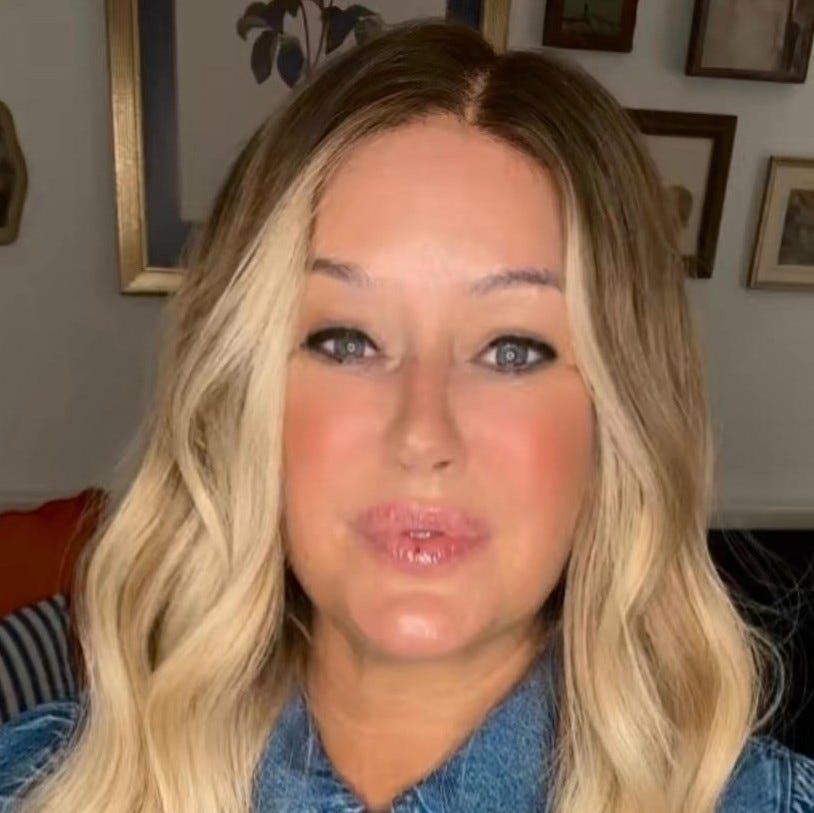
Jennie Gage grew up in a “very traditional” Mormon family, with roots in the church stretching all the way back to her great-grandparents.
But she had an independent streak. When Jennie was about 7, she tested as gifted and went to a school with a program for gifted kids. “I loved it,” she says in her testimonial at Leaving MAGA. “We were doing amazing stuff, in particular learning critical thinking and problem-solving. I felt like my brain was being tickled.”
One day in Sunday school, Jennie’s teacher related the tale of the Golden Plates (described as plates engraved in Egyptian script from which Mormonism founder Joseph Smith translated the Book of Mormon). Eight-year-old Jennie had questions. “‘Where are the plates?’ I asked. ‘The angel Moroni took them,’ my teacher said.”
Driving home from church that day, “I told my parents I didn’t see any evidence that Joseph Smith found the Golden Plates, so I didn’t think it was true. My mom started crying, telling me I just had to believe, because it was a miracle.”
Jennie’s family, church and community tried to keep her in line, “to just say ‘Yes, sir’ and accept that the prophet and our bishop had final authority. They burned into me the idea that critical thinking was worldly (bad).”
She chafed at the restrictions. By the time she graduated from high school, the church had prepared her to be a “trad wife,” but “I didn’t want to be a traditional Mormon wife and mom.” At the same time, “I was told the prophet wanted me to be a mom, that Jesus wanted me to stay home and have babies. I figured I had to abandon my desires, because it was just Satan trying to pull me away from my family.”
Jennie enrolled at Ricks College (now BYU Idaho) in Rexburg, Idaho. She soon met someone, fell in love, and got engaged. “But he hadn’t gone on his two-year Mormon mission yet, and I said he had to do that first before we got married.”
Jennied graduated with an AA in Russian and a minor in political science, and went home to Portland for the summer. That’s when an adult leader in her congregation told her “the Holy Ghost” revealed to him that she was supposed to marry someone other than her fiancé. “I was raised to believe the Holy Ghost spoke to people, so I reluctantly agreed to meet with Jake (not his real name),” she says.
“On our second date, he molested me. Jake felt bad about it, so we went to confess to the bishop. When Jake told him what he’d done, the bishop said, ‘We need to hurry up and get you guys married.’ The wedding was six weeks later. I married a stranger who had molested me.” It was 1994, and Jennie had just turned 20.
She describes her marriage as “a nightmare,” filled with ongoing physical abuse. “I wanted to get a divorce, but everyone said I couldn’t because we’d been married in a Mormon temple.”
The year after they married, Jennie and Jake bought a friend’s windshield installation business. “For a number of years we were quite well off,” she says. “We built a brand new home. We drove Mercedes and BMW’s. We vacationed in Hawaii.” Meanwhile, “Jake was regularly abusing me. I constantly wanted to die; I had anxiety, depression.”
After Jennie had her first baby, a lay church leader forced her to step away from the business and focus on being a housewife and mom. She kept working unofficially, “but I never got paid. I thought I was obeying God’s commandment.”
Jennie and Jake “were very conservative, very Republican. As good Mormons, we were waiting for Jesus to come back any day. I didn’t think I’d live long enough to have grandkids.” In addition, “white supremacy was baked into our belief system. The Book of Mormon says white people are better, and dark-skinned people are cursed. We were anti-abortion and we thought homosexuality was the most evil thing in the world.”
Jennie never missed an episode of Rush Limbaugh’s show. “I listened to Glenn Beck quite a bit. My granddad, who was one of my best friends, was ultra-conservative. I listened exclusively to Fox News when it came along. I never watched the mainstream networks or CNN.”
In 2011, complications from surgery for a benign ovarian tumor and a resulting superbacteria “nearly killed me…We had never bothered to get health insurance, so I wasn’t able to get some of the care I needed. I was in and out of the hospital for years…we ended up in medical bankruptcy.” Jennie says Jake’s physical abuse got worse during this period.
Two years later, while Jennie was still dealing with her medical issues, they moved to Travelers Rest, South Carolina and built a small house. “It was there that I got radicalized into Christian fundamentalism and a more extreme form of racism,” she says.
“Our neighbors were ‘normal’ people: they lived in beautiful homes, tended their farms, raised their horses. They went to church on Sundays, had big happy families with cute little housewives and successful dads. And many of them were in the Ku Klux Klan. One said he was the local Grand Wizard, and invited Jake to join.”
They didn’t join, “because Mormons don’t believe in joining other groups and are non-violent.” But Jennie says she “did become a sympathizer…I was an easy target. Because of my Mormon upbringing, I already believed dark skin was a curse from God.”
When Donald Trump ran for president the first time, Jennie “enthusiastically supported him. I was already a longtime fan; I had fallen in love with Trump watching The Apprentice. I never missed an episode. I was obsessed with his whole persona. He was so intriguing to me; he was like my rich Mormon uncles with his fancy houses. I had The Art of the Deal and The Art of the Comeback. I underlined passages and wrote notes in the margins.”
She “felt euphoric that America had the possibility to have this incredibly smart businessman running our country. On top of that, my Mormonism prepared me to embrace Trump and MAGA. We were taught that God made America as a promised land for his most righteous children. Christian Nationalism was a natural outgrowth of my religion. We mixed America with the gospel; I believed the Constitution was written by God, and that the national anthem and ‘God Bless America’ were religious songs.”
Jennie believed Trump had converted to Christianity. “It was so impressive to me that this rich New York playboy who’d spent his younger days carousing had now found Jesus. Now he was this family man who was called by God to lead the country.”
While campaigning in Salt Lake City, Trump said “he owned a copy of the Book of Mormon. Rumors spread throughout our community that he had read it. I prayed every day that he would convert to our church.”
She says “MAGA became my whole identity. Trump was my personal profile picture on social media. I posted love letters to him.”
Trump’s hate of foreigners, lesbians, gay people, and trans people resonated with Jennie. “Every Sunday in church we were taught that half of humanity was going to burn in hell…and Trump really played into that. So whenever he said something hateful, I really enjoyed it. Here was someone who as president was going to call out the people who were evil.”
She did have to “engage in a lot of mental gymnastics to deal with all the cognitive dissonance around lesbians and gays.” (She had made a number of lesbian friends several years earlier after getting involved in selling essential oils.) “But I stopped myself from connecting the dots,” Jennie says. “I kept telling myself that living a religious life and following Jesus was the way to happiness, and that if I was unhappy, it was because of Satan.”
Trump’s mocking of a disabled reporter didn’t bother her. “As a Mormon, I believed disabled people had sinned or done something that prevented them from receiving God’s healing.” When the Access Hollywood tape came out, “I viewed the episode as part of Satan’s effort to prevent Trump from becoming president.”
When Trump became president in 2017, “I felt [he] was running the country like the Mormon prophet was running the church…His authoritarian streak, his banning people from the country, his claim there were ‘fine people on both sides’ after Charlottesville, that all really resonated with me. Remember, I lived in a religious community that was always banning everything. I wasn’t allowed to watch certain movies, listen to certain music, or even wear my own underwear. They assigned me my husband, and my panties.”
The Mormon church “was a dictatorship, so I wasn’t used to democracy. I questioned why we needed democracy.”
After a brief separation, Jennie reunited with Jake in Arizona. But he was as abusive as ever. About a month later, on Oct. 7, 2018, she went to church “really stressed out.” The first hour was dedicated “to telling us women aren’t supposed to work. I looked around at the working women in the congregation, including a doctor and schoolteacher. For some reason, the judgement and hatred in those remarks really hit me hard.”
Then several dozen of the women spent an hour in Sunday school. “The preacher said the Holocaust happened because the Jews killed Jesus,” she recalls. “I couldn’t believe everyone sat there unquestioningly.”
After that, they were given another sermon “on the evils of homosexuality,” and something snapped in Jennie. “I thought of my old lesbian friends, of a gay cousin my family had shunned. All of a sudden, I connected the dots. My hands were shaking. It was almost like an out-of-body experience.”
She thought to herself, “I come to church to learn how to love people better, not to learn how to hate. But the church had preached hate my whole life. I raised my hand, I stood up, grabbed my purse and keys, and announced I was leaving the church because of the lesson.”
Jennie and Jake joined a Christian church; a few weeks later, she caught Jake meeting a prostitute. Jennie finally ended their 24-year marriage.
“He cleaned out our bank account, wiped me out financially,” she says. “I had lost my faith in God, my belief in everything, and Jake was about to take my kids. In early December 2018, I tried to kill myself through carbon monixide poisoning.”
A neighbor rescued her. She spent 10 days in a coma. When she came to, “I decided that I had to deconstruct everything I had believed in and build a new life for myself. I used my critical thinking skills, questioning what I believed about the Bible, about Jesus, about marriage and gender roles. That began my journey out of MAGA.”
Jennie was homeless for a few months, and almost died from Covid when the pandemic hit. After a commitment ceremony with her new partner in 2021, “I started doing TikTok videos, talking about how I left the Mormon church. I went viral, and suddenly I had this massive community.”
Thousands of people would comment, saying they went through similar things. “At that point my journey out of MAGA accelerated,” she says. “I read books on racism, feminism, and gender…I befriended [liberal] creators, authors, and influencers…I was getting an education I’d never had…I unraveled and rejected the racism that had defined me.”
Jennie continues: “My previous worldview collapsed. I realized most of what I’d believed wasn’t true. A couple of years ago I left Christianity…One day, I burned my Bible in my backyard fire pit. That was very therapeutic.”
When Trump ran again for president in 2024, “I completed my journey out of MAGA,” she says. “I was going to give Trump one more chance. I think I wanted to cling to something from my old life that I thought made sense. I watched Trump at his rallies, and I heard the same hatred I heard in the Mormon church and in my Christian church. It struck me that he sounded like my narcissistic ex-husband.”
She researched the positions of the two major parties, and “I found myself agreeing with the Democrats.”
Jennie decided to share “what it was like to be part of MAGA, what it looked like to be a white supremacist. I posted a video about being ex-MAGA to my YouTube channel, and it went super viral. I have started to build a community of people from all over the country who are ex-MAGA, ex-Mormon, ex-evangelical, ex-Catholic.”
She’s “so gratified by the comments people leave on my TikTok: ‘I just graduated from college because of you.’ ‘I left my abusive husband.’” She says politics are now a big part of her life. “I’ve become a women’s rights activist…I just took a job with a national organization that helps domestic violence survivors. I volunteer with Secular Arizona. I go to school board meetings.”
Jennie goes on: “I know the playbook…I know what they’re thinking. I’ve sat at the dinner table with Christian Nationalist relatives and heard how they hate everybody and how we should have a theocracy. Watching Trump carry out that agenda is terrifying. When he started implementing all those Project 2025 proposals, I felt like, ‘See? That’s what I’ve been warning about.’”
The way she sees it, Trump “became the Grand Wizard of every Christian Nationalist group in the United States. It’s the ultimate political/religious merger.”
Jennie adds: “I used to be a hateful, horrible person, trapped in a cult. Now I’m trying to build a life based on common sense, compassion, and empathy. I’m working hard to push back against everything I once stood for and change the world. It’s the least I can do.”
You can read the stories of many others who have left MAGA on The Paulemic and at Leaving MAGA, where we also have a guide for talking to friends and family who are in MAGA.
Wow, the candor Jennie gives about her beliefs while in the Mormon and MAGA cults are staggering and oh so courageous. Her story is exactly why I feel it is disingenuous and incomplete to be a therapist working with former Mormons and not also speaking about the harmful beliefs that marry with MAGA—and how we must support deconstructing both!
Thank you for sharing these stories.